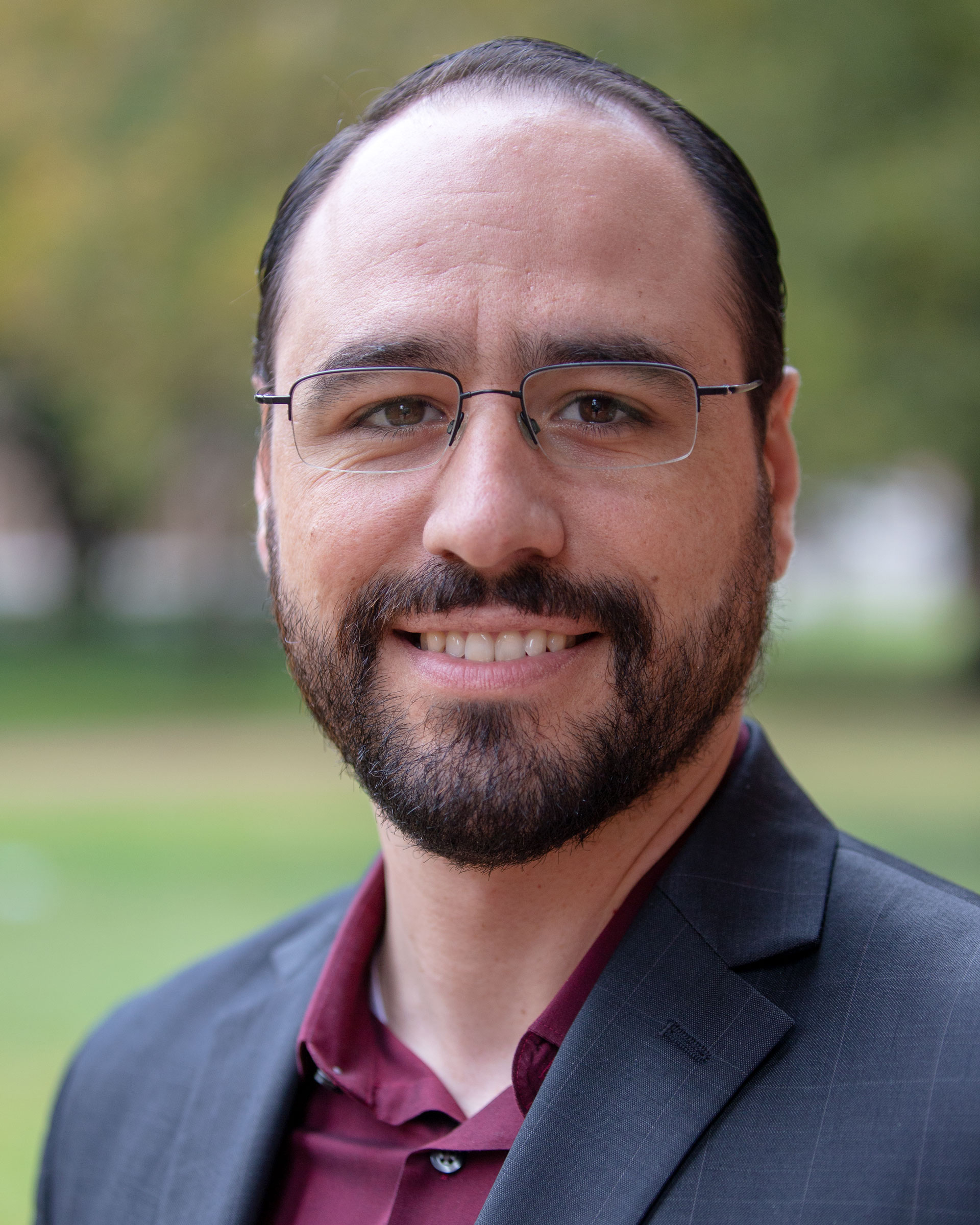
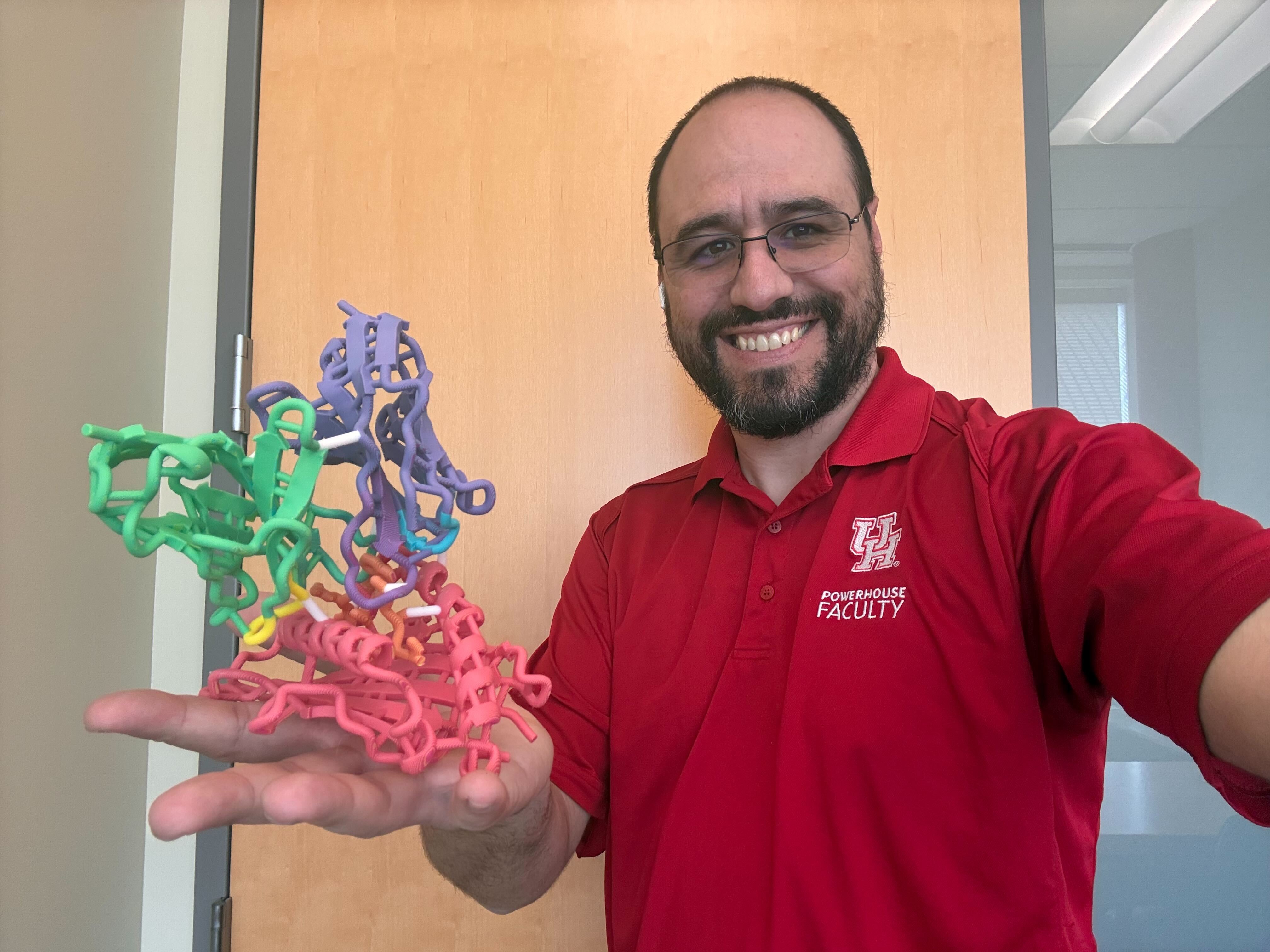
I am an Assistant Professor of Computational Biology at the Department of Biology and Biochemistry of the University of Houston. I am a member of the Center for Nuclear Receptors and Cell Signaling (CNRCS), located at the Science & Engineering Research Center Bldg 545 (SERC, Suite 3007). I work with structural modeling and analysis of protein-ligand complexes that play key roles in cellular immunity. My research will facilitate the development of safer and better personalized immunotherapy treatments, enabling structure-based selection of peptides that can be targeted by the immune system (e.g., tumor neoantigens), and computational prediction of dangerous off-target toxicities.
I attained my bachelor’s degree (BS) in Biomedicine in 2008, at the Federal University of Rio Grande do Sul (UFRGS, Brazil), and received my master’s degree (MS) in Genetics and Molecular Biology from the same university in 2011. During my doctorate degree (DSc), concluded in 2014, I applied bioinformatics tools to identify molecular features responsible for complex immunological phenomena, such as heterologous immunity. My research enabled in silico predictions of T cell cross-reactivity among viral epitopes, which were later confirmed by in vitro experiments. Later, I developed my postdoctoral studies at the Computer Science Department of Rice University (Houston, TX), with a fellowship from the Computational Cancer Biology Training Program (CCBTP). During this time I worked in collaboration with a team from MD Anderson Cancer Center on the development of structure-based methods that can be used to improve peptide-target selection in personalized cancer immunotherapy. One of the outcomes of this project was the modeling environment HLA-Arena. I am also a permanent contributor of the Brazilian Society of Immunology Blog (SBlogI).
More details can be found in my curriculum vitae.
News
Follow me on Bluesky (@dinler.bsky,social) for the latest updates.
- Our collaborative study, “Upgrading the HIV vaccine paradigm: accounting for host-pathogen diversity through geotargeting-based vaccine design,” has been published in Frontiers in Cellular and Infection Microbiology. We combined HLA allele frequencies and HIV-1 subtype diversity across African countries with predictions of antigen processing and presentation, to identify epitope targets better matched to the host-pathogen landscape of specific regions (2026).
- Our paper, “Substrate secondary structure is associated with proteasomal cleavage propensity,” has been published in Frontiers in Bioinformatics. We show that predicted proteasomal cleavage sites tend to fall within beta-strand regions and away from coils, and that a machine learning model using only predicted secondary structure features performs on par with a sequence-based control, with the clearest signal for the immunoproteasome (2026).
- Our lab was awarded a new grant from the National Cancer Institute (NCI/NIH), “Integrating Single-Cell TCR Landscapes and Structural Fingerprints to Advance Leukemia Immunotherapies” (1R56CA304245), in collaboration with Dr. Hussein Abbas at MD Anderson Cancer Center (2026).
- CrossDome2 is now live! Our tool for assessing off-target toxicity in T-cell-based immunotherapy is available as a web server, a REST API, and a Python-based command-line interface, backed by an expanded immunopeptidomics database. Source code is on GitHub.
- Our review paper, “Mapping the TCR landscape: computational tools empowering translational immunology and therapy design,” has been published in the Journal for ImmunoTherapy of Cancer (JITC).
- Congrats to Finn Beruldsen on winning the James P. Taylor Foundation Scholarship for GCC2026 (Clermont-Ferrand, France) (2026)!
- Congrats to Jaila Lewis on winning the Best Poster Award at the 30th Structural Biology Annual Symposium (UTMB, Galveston) (2026)!
- Congrats to Jaila Lewis on winning Best Oral Presentation at the Bioscience Graduate Society Symposium (UH, Houston) (2026)!
- Our work on RMSX and Flipbook, packages for user-friendly and intuitive high-resolution mapping of molecular motions over time, was accepted for publication in the Scientific Reports Journal (Nature Publishing Group). RMSX combines features from both RMSD and RMSF to analyze time-resolved residue-level motions, and Flippbook supports visualization of snapshoots of the trajectory highlighting these movements, using either VMD or UCSF ChimeraX. A preprint of the manuscript can be found here.
- AI-based structural modeling of TCR and their targets: Advances and Limitations. Invited talk at the “Leveraging the Power of Artificial Intelligence to Foster Progress in Immuno-oncology: Opportunities and Challenges”, a Pre-Conference event of the 40th Anniversary SITC symposium. National Harbor, MD, US. November 6, 2025.
For more, check the News Archive.
Address
3517 Cullen Blvd. Science & Engineering Research Center (SERC) Bldg 545, Suite 3007. Houston, TX 77204-5056